Quantum Computing / Notes / Quantum Theory
Understanding the Blackbody radiation in Tamil
Summary
This lecture presents an in-depth explanation of blackbody radiation, a foundational concept in quantum mechanics. Starting from classical physics' challenges, particularly the ultraviolet catastrophe problem inherent in Rayleigh-Jeans law, the discussion covers how the emission of electromagnetic radiation by matter led to critical developments in quantum theory. The concept of a blackbody as an ideal absorber and emitter of energy is explained through examples, such as black iron and colored clothing, illustrating its distinctive physical properties. The failure of classical laws in explaining radiation spectra necessitated Max Planck’s revolutionary idea: light behaves as discrete packets or quanta (photons). This discovery paved the way for quantum mechanics and modern technologies like LEDs, solar panels, and photoelectric sensors, which are briefly introduced. The lecture outlines the historical context, fundamental physics principles, and applications of blackbody radiation, setting the stage for future topics on quantum computing and quantum field theory.
Highlights
- Blackbody: An idealized object that perfectly absorbs and emits energy as thermal radiation.
- Temperature-dependent spectrum: Radiation color and intensity depend on the blackbody’s temperature; e.g., from red-hot iron to white-hot stars.
- Ultraviolet catastrophe: Classical physics wrongly predicted infinite energy at short wavelengths, resolved by quantum theory.
- Max Planck’s quantum hypothesis: Light is emitted in discrete packets called photons.
- Technological impact: Blackbody concepts underpin modern devices like solar panels, LEDs, and light sensors.
- Wavelength and energy: Visible light spans approximately 400–700 nanometers; energy emission varies by wavelength.
- Ongoing learning: This lecture is part of a series covering quantum mechanics fundamentals progressing towards quantum computing.
Key Insights
-
Blackbody as a theoretical standard:
A blackbody is defined not just by absorbing all incoming electromagnetic radiation but by reradiating energy based on temperature with no reflection or transmission. This concept, though idealized and unattainable perfectly, serves as a critical reference to understand thermal radiation and color phenomena in physical objects, helping explain why materials appear black or colored. -
Color and light wavelength explained via energy absorption and emission:
The human perception of colors results from selective absorption and emission of specific wavelengths by materials. For example, a red shirt absorbs most wavelengths except red, which it reflects. This selective interaction clarifies why color is inherently linked to the object's material properties and temperature-dependent radiation spectrum from blackbody theory.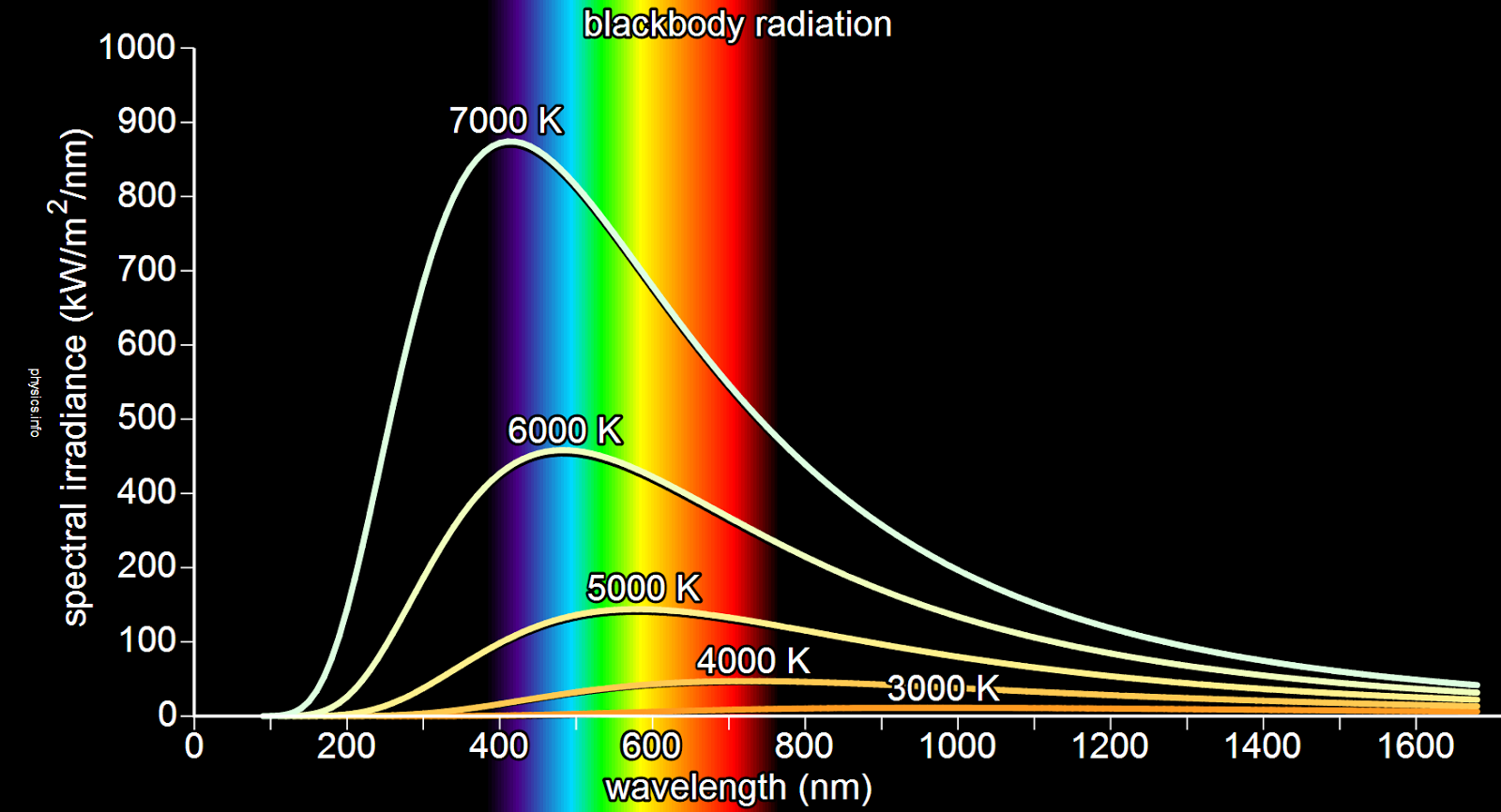
-
Classical physics limitations and the ultraviolet catastrophe:
Rayleigh-Jeans law predicted unphysical infinite energy emission at ultraviolet wavelengths (“UV catastrophe”). This failure showcased the inability of continuous wave theories to explain blackbody spectra, highlighting fundamental gaps in physics that prompted new quantum hypotheses. -
Planck’s quantization revolutionized physics:
Max Planck introduced the idea that energy emissions are quantized into discrete photons rather than continuous waves. This quantum interpretation resolved the ultraviolet catastrophe, explaining observed blackbody radiation spectra and marking the birth of quantum mechanics, which have vast implications beyond fundamental physics to practical tech. -
Practical relevance in electronics and photonics:
The photoelectric effect, where photons eject electrons from materials, explains how solar panels generate electricity and how LEDs emit light efficiently. Understanding blackbody radiation and photon interactions is essential for optimizing these semiconductor-based technologies widely used today. -
Astrophysical applications and temperature measurement:
Blackbody radiation principles help scientists determine stellar temperatures and compositions by analyzing emitted light wavelengths. Instruments like the Hubble and James Webb telescopes rely on this theory to study distant cosmic objects and even detect exoplanets by analyzing their radiation signatures. -
Progression toward quantum computing:
The lecture series uses blackbody radiation as a stepping stone to explore quantum field theory, quantum optics, and quantum computing frameworks. Understanding energy quantization and photon behavior builds foundational knowledge essential for appreciating how quantum computers manipulate information using quantum states.
This session effectively merges theoretical exposition and practical implications of blackbody radiation, emphasizing its pivotal role in the advancement of modern physics and enabling technologies.
Further reading
Updated 11 Nov 2026